Build a Full SaaS Application in 100 Days: The Ultimate Guide for Startups & Stealth Founders
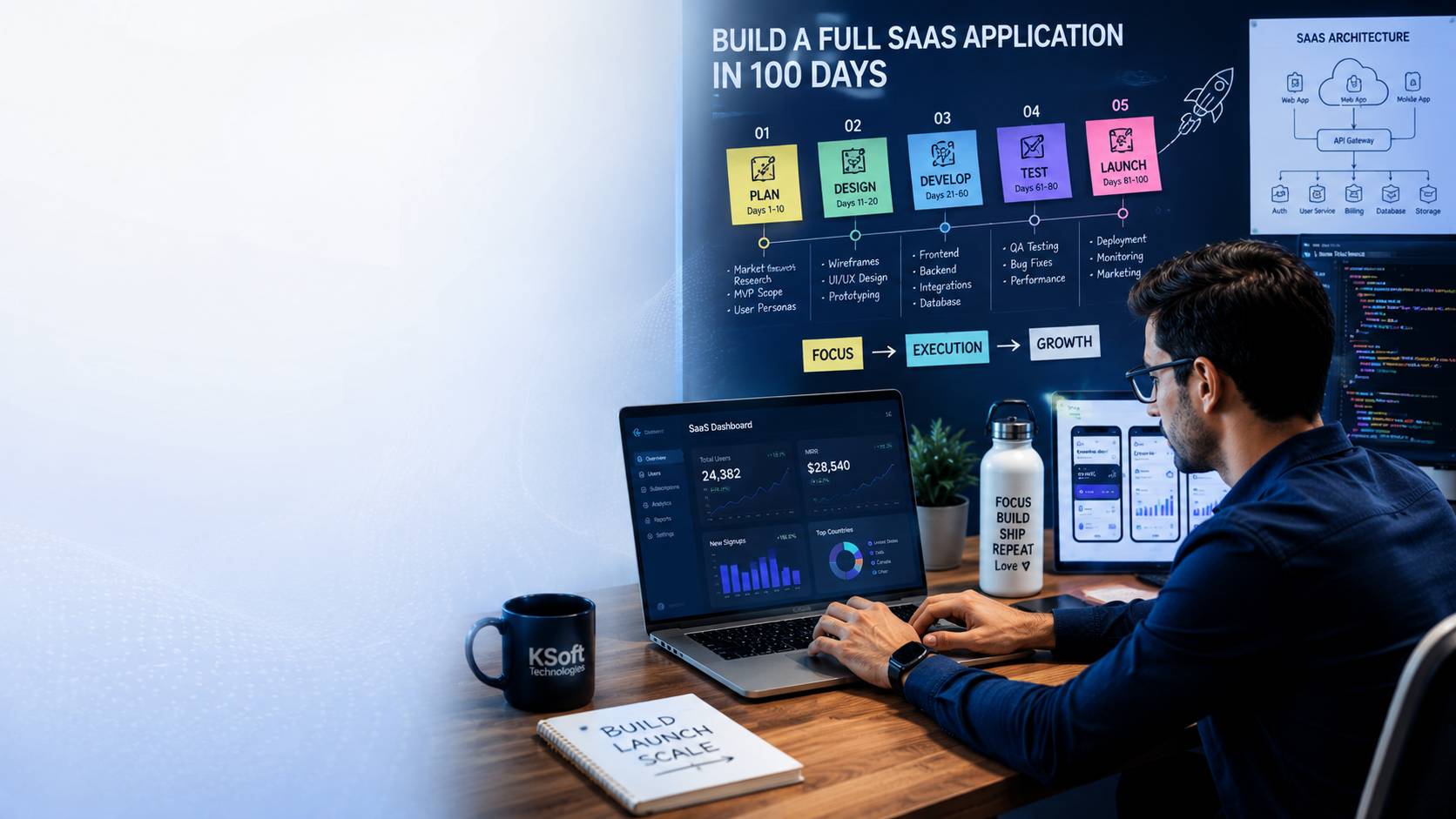
But for a startup founder, stealth founder, or early-stage SaaS team, speed is often the difference between testing a market opportunity and watching someone else capture it first.
The challenge is not simply building fast.
The real challenge is building fast without creating a product that breaks after the first few customers, confuses users, or requires a complete rebuild after launch.
A 100-day SaaS build needs strategy, technical discipline, founder focus, and ruthless prioritization.
This guide breaks down how startups can move from idea to launch-ready SaaS product in 100 days with a practical roadmap covering product planning, MVP scope, SaaS architecture, UI/UX design, development, testing, deployment, launch, and post-launch improvements.
Yes, a startup can build and launch a focused SaaS application in 100 days if the scope is clearly defined, the MVP includes only essential workflows, the architecture is planned early, and the development team works in structured sprints. A realistic 100-day SaaS roadmap usually includes discovery, product planning, UI/UX design, core development, testing, deployment, and launch preparation.
Most SaaS founders want to start with features.
But the better starting point is the business case.
Before writing code, founders should answer:
A 100-day timeline does not allow unclear thinking.
Every unclear decision becomes a delay later.
That is why the first stage of SaaS development should focus on clarity, not coding.
Before investing months into development, founders need a focused product scope, scalable architecture plan, and launch strategy. The right roadmap can help you move faster without wasting budget on unnecessary features.
Building a SaaS application in 100 days sounds ambitious.
Quick Answer: Can You Build a SaaS Application in 100 Days?
The 100-Day SaaS Rule: Build the Business Case Before the Product
Have a SaaS Idea But Not a Clear Roadmap?
The first 10 days decide whether the next 90 days will be productive or chaotic.
This phase should focus on:
A strong SaaS application does not solve 20 problems at once.
It solves one important problem extremely well.
For example:
Start with the workflow that creates the clearest user value.
The MVP boundary is the line between what must be built now and what can wait.
A strong SaaS MVP usually includes:
Features like advanced analytics, AI automation, mobile apps, complex integrations, and enterprise controls can often be planned for later phases unless they are central to the product’s value.
A SaaS product is not just a website with login.
It needs a technical foundation that can support multiple users, organizations, roles, data security, billing, and future growth.
Founders should avoid treating architecture as a later problem.
Bad architecture does not usually fail on day one.
It fails when users increase, data grows, permissions become complex, and customers ask for reliability.
A practical SaaS stack may include:
KSoft Technologies commonly works with startup-focused technologies like Next.js, React, Node.js, PHP/Laravel, MySQL, Flutter, Tailwind CSS, and cloud platforms, which makes this type of SaaS roadmap practical for founder-led product builds.
Many SaaS products fail because the experience feels confusing.
The user logs in and immediately asks:
“What should I do now?”
That is a UX failure.
During days 21–35, the focus should be on designing clear product flows before development accelerates.
Map the core journey:
Every SaaS screen should support that journey.
Empty states are especially important.
A new SaaS user often begins with no data. The product should guide them clearly instead of showing blank screens.
This is where the product starts becoming real.
But the goal is not to build everything.
The goal is to build the core product engine.
Feature creep is the biggest enemy of a 100-day SaaS launch.
Founders should divide every feature into three categories:
If a feature does not help users reach the core value quickly, it should probably wait.
A focused MVP can help you validate faster, control development cost, and avoid unnecessary rebuilds. KSoft Technologies helps founders define the right SaaS scope, architecture, and launch path before development begins.
Phase 1: Days 1–10 — SaaS Discovery and Product Strategy
Define the Core SaaS Problem
Choose the MVP Boundary
Phase 2: Days 11–20 — Architecture, Tech Stack, and SaaS Foundation
Important SaaS Architecture Decisions
Recommended SaaS Tech Stack
Phase 3: Days 21–35 — UI/UX Design and Clickable Product Flow
Design the Main User Journey First
SaaS Screens to Design Early
Phase 4: Days 36–65 — Core SaaS Development Sprint
What Should Be Built During the Main Development Sprint?
How to Avoid Feature Creep
Building a SaaS MVP and Worried About Scope Creep?
A SaaS application should not be launched just because the screens look complete.
Testing is where the product becomes dependable.
Security should not be an afterthought.
At minimum, founders should ensure:
For B2B SaaS products, trust is part of the product.
If users cannot trust the system with their data, they will not trust the business.
The first version of a SaaS product should be tested with real users before public launch.
This beta phase should not be treated as a casual demo.
It should be structured.
The goal of beta testing is not praise.
The goal is learning.
The final 10 days are about preparing the SaaS product for real market exposure.
This includes product launch, analytics setup, landing page readiness, support workflows, and founder-led growth activity.
A SaaS launch is the beginning of the learning cycle.
After launch, founders should monitor:
The first 100 days help you launch.
The next 100 days help you scale.
More features do not automatically create more value. A cluttered SaaS product often makes onboarding harder and slows down development.
A SaaS product needs scalable structure from the beginning, especially around users, roles, organizations, billing, and data separation.
Founders who wait until the product is perfect often discover too late that users wanted something different.
Good UI/UX is not just visual design. It helps users understand value faster.
Without analytics, founders cannot see what users are doing, where they drop off, or what needs improvement.
A strong SaaS MVP should include enough functionality to deliver the core product promise.
For most SaaS applications, that means:
The MVP should be small enough to launch quickly but strong enough to support real users.
Stealth founders often face a different challenge.
They need speed, confidentiality, and product clarity without public exposure.
For stealth SaaS products, founders should prioritize:
This is where working with a privacy-first development partner becomes valuable.
KSoft Technologies positions its product development process around NDA protection, business-first discovery, transparent delivery, and long-term technical partnership, which is especially useful for stealth founders building sensitive SaaS ideas.
Phase 5: Days 66–80 — Testing, Security, and Product Hardening
Critical SaaS Testing Areas
Security Checks Before SaaS Launch
Phase 6: Days 81–90 — Beta Launch and Founder Feedback Loop
What to Track During Beta
Best Beta User Questions
Phase 7: Days 91–100 — Launch, Analytics, and Growth Readiness
100-Day SaaS Launch Checklist
Launch Is Not the Finish Line
Common Mistakes Founders Make When Building SaaS Fast
1. Building Too Many Features
2. Ignoring SaaS Architecture
3. Delaying User Feedback
4. Treating UI as Decoration
5. Launching Without Analytics
What Should a SaaS MVP Include?
How Stealth Founders Should Approach a 100-Day SaaS Build
100-Day SaaS Development Roadmap Summary
Timeline
Focus Area
Key Outcome
Days 1–10
Discovery and product strategy
Clear SaaS scope and MVP roadmap
Days 11–20
Architecture and tech stack
Scalable technical foundation
Days 21–35
UI/UX design
Clickable SaaS product flow
Days 36–65
Core development
Working SaaS application
Days 66–80
Testing and security
Stable and reliable product
Days 81–90
Beta launch
Real user feedback
Days 91–100
Public launch readiness
Market-ready SaaS product
If you are a startup founder, stealth founder, or SaaS entrepreneur planning to build fast, the right technical roadmap can help you avoid delays, rebuilds, and unnecessary features.
KSoft Technologies helps startups plan, design, develop, and launch scalable SaaS MVPs with business-first thinking and production-ready engineering.
Founder Checklist Before Starting a 100-Day SaaS Build
Ready to Turn Your SaaS Idea Into a Launch-Ready Product?
Yes. A focused SaaS application can be built in 100 days if the MVP scope is clear, the architecture is planned early, and the team follows structured development sprints.
The first step is defining the target customer, core problem, product scope, revenue model, and MVP feature list before development begins.
A SaaS MVP should include authentication, user roles, core dashboard, main workflow, admin controls, basic reporting, payment readiness, and cloud deployment.
A focused SaaS MVP can often be built in 4–12 weeks depending on complexity, integrations, design requirements, and technical architecture.
The biggest mistake is building too many features before validating the core problem and user demand.
Yes. Stealth founders should use NDA protection before sharing product ideas, business logic, workflows, or technical documentation.
Common SaaS technologies include Next.js, React, Node.js, Laravel, Python, MySQL, PostgreSQL, AWS, Azure, and cloud-based deployment tools.
Most B2B SaaS products should begin with a web application. Mobile apps can be added if the user workflow requires frequent mobile access.
Divide features into must-have, should-have, and future-release categories. Build only the features needed to deliver the core product value.
UI/UX helps users understand the product quickly, complete workflows easily, and experience value faster, which improves activation and retention.
Testing should begin during development and continue through beta launch, security checks, user acceptance testing, and post-launch monitoring.
Founders should track activation rate, trial-to-paid conversion, retention, feature adoption, churn signals, user feedback, and support requests.
Yes. Funded startups can use a 100-day SaaS roadmap to launch faster, validate the market, and show traction before larger-scale investment.
Yes. Pre-seed startups can use this roadmap to build a focused MVP, attract early users, and prepare stronger investor conversations.
After the first 100 days, founders should improve onboarding, refine features, monitor analytics, strengthen retention, and plan scalable growth.
Building a full SaaS application in 100 days is not about rushing.
It is about removing confusion, focusing on the right features, planning architecture early, testing with real users, and launching with enough quality to support growth.
For startup founders and stealth founders, the 100-day roadmap creates discipline.
It forces clear decisions.
It prevents endless feature planning.
It turns a SaaS idea into a real product that can be tested, improved, and scaled.
The founders who win are not always the ones who build the biggest first version.
They are the ones who build the right first version, launch it intelligently, and learn faster than the market expects.
Frequently Asked Questions
Can a SaaS application really be built in 100 days?
What is the first step in building a SaaS application?
What should be included in a SaaS MVP?
How long does it take to build a SaaS MVP?
What is the biggest mistake SaaS founders make?
Do stealth founders need an NDA before SaaS development?
Which technology is best for SaaS development?
Should SaaS founders build web or mobile first?How do I avoid scope creep during SaaS development?
What is the role of UI/UX in SaaS success?
When should I start testing my SaaS product?
What should founders measure after SaaS launch?
Is a 100-day SaaS build suitable for funded startups?
Is a 100-day SaaS build suitable for pre-seed startups?
What happens after the first 100 days?
Final Thoughts
Working through this in your own startup? Mentorship is where the clarity starts.
Apply for mentorship →