How to Build an MVP in 30 Days: The 2026 Founder Playbook for Faster Startup Growth
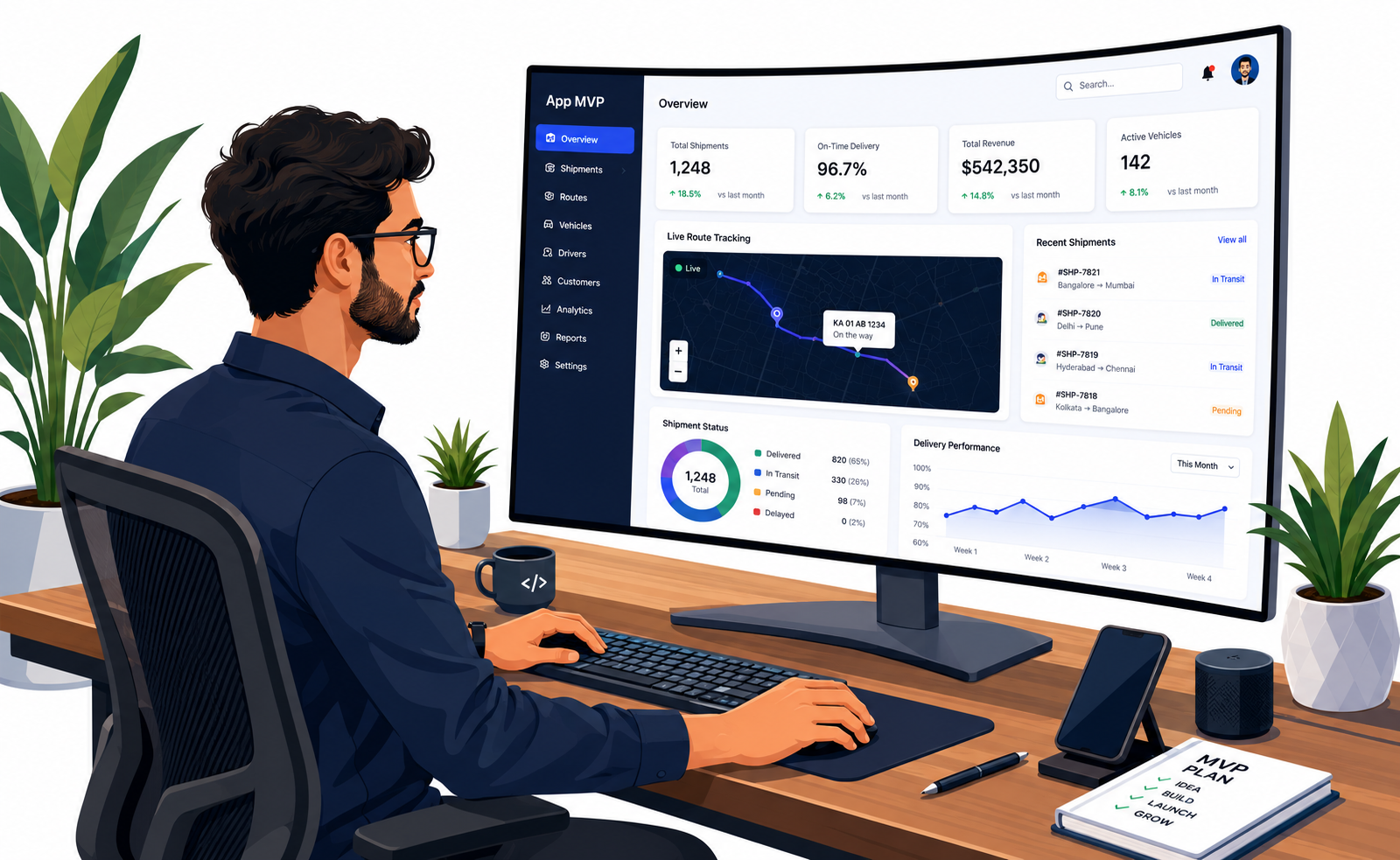
Right now, somewhere in your industry, a startup with fewer resources than you is launching faster, reaching customers earlier, and collecting real market feedback while everyone else is still planning features.
That’s the biggest shift happening in 2026.
Founders are no longer winning because they have the biggest development teams. They’re winning because they move faster.
The startups growing aggressively today are launching lean MVPs in weeks, validating demand quickly, and entering investor conversations with real traction instead of just pitch decks.
And the companies falling behind?
They’re still trapped in endless planning cycles, bloated product roadmaps, and six-month development timelines that no longer match the speed of the market.
Learning how to build an MVP is no longer just a product strategy skill. In 2026, it’s a survival advantage.
The real value of an MVP isn’t the product itself. It’s what happens after launch — customer traction, market validation, investor confidence, and momentum.
Modern founders are now using AI-assisted workflows with tools like Cursor AI, Claude Code, GitHub Copilot, Replit, and Vercel to reduce development time dramatically without sacrificing execution quality.
The result?
Products launch faster. Customer conversations happen earlier. Businesses adapt quicker. Competitors struggle to catch up.
Book a Free MVP Strategy Session →
Get a realistic roadmap, timeline, architecture strategy, and launch plan tailored to your startup idea.
Why Most Startups Lose Momentum Before They Even Launch
Most startups don’t fail because the idea is bad.
They fail because execution takes too long.
Founders often spend months building features users never asked for, investing heavily before validating whether customers even care.
Meanwhile, faster competitors launch simpler products, start collecting feedback immediately, and improve rapidly using real-world usage data.
The market rewards momentum.
Not perfection.
One of the biggest misconceptions founders still have is believing that launching early damages credibility.
In reality, launching early often creates the opposite effect:
- Customers feel involved in the journey
- Investors see execution speed
- Teams gain clarity faster
- Product direction improves quickly
- Burn rate stays lower
The companies dominating markets in 2026 are usually the ones learning faster than everyone else.
What an MVP Actually Gives Founders in 2026
An MVP is not just a lightweight version of a product anymore.
It’s a business acceleration tool.
A properly executed MVP helps founders:
- Validate demand before scaling costs
- Enter the market before competitors
- Reduce wasted engineering investment
- Get early customer traction
- Improve investor conversations
- Build confidence with real user feedback
That’s the real treasure founders get at the end of the journey.
Not “an app.”
Momentum.
Because once users start engaging with the product, everything changes:
- You stop guessing
- You start seeing real patterns
- You understand what customers actually value
- Your roadmap becomes clearer
- Your startup becomes more investable
The best MVPs don’t just validate products. They reduce uncertainty for the entire business.
How to Build an MVP Step-by-Step
Step 1: Focus on the Pain, Not the Features
The strongest startups solve one painful workflow extremely well.
Weak MVPs try solving ten problems at once.
Before development starts, experienced founders ask:
- What frustrates users the most?
- What process wastes their time or money?
- Why are current tools failing them?
- Why is this problem urgent now?
For example:
- A logistics startup reducing delivery delays
- An AI HR platform speeding up hiring
- A fintech SaaS automating invoice follow-ups
The narrower the focus, the faster startups usually reach product-market fit.
Step 2: Validate Before Writing Code
One of the fastest ways to waste startup capital is building before validating.
Modern lean startup teams now validate ideas using:
- Landing page testing
- Waitlists
- Founder interviews
- Beta signups
- Community feedback
- Competitor gap analysis
Validation creates clarity.
And clarity dramatically reduces MVP development cost because founders stop building unnecessary features.
The startups scaling fastest in 2026 are often the ones obsessing over customer conversations before development even begins.
Step 3: Build Only What Creates Immediate Value
This is where most startup timelines collapse.
Every feature starts feeling important.
But experienced product teams know something important:
The first version of your product is not supposed to impress everyone. It’s supposed to solve one painful problem clearly.
Example:
Project Management SaaS MVP
Essential Features:
- User authentication
- Create tasks
- Assign tasks
- Notifications
Features to Delay:
- Advanced analytics
- Complex AI automation
- Enterprise permissions
- Custom integrations
- Multi-language support
Overbuilding destroys momentum.
And momentum is one of the most valuable assets a startup can have.
Step 4: Use AI-Assisted Development to Move Faster
This is one of the biggest competitive shifts happening right now.
Modern startups are increasingly combining experienced developers with AI-powered coding workflows to accelerate execution dramatically.
Popular tools include:
- Cursor AI for rapid code generation
- Claude Code for debugging and reasoning
- GitHub Copilot for productivity acceleration
- Replit for fast prototyping
- Vercel for scalable deployment
The founders benefiting most from AI are not replacing developers.
They’re eliminating unnecessary delays.
That changes everything:
- Faster launches
- Lower development costs
- Quicker iteration cycles
- Earlier customer feedback
- Faster product evolution
Book Your Free MVP Consultation →
Learn the exact framework high-growth startups use to validate products and launch faster.
Step 5: Launch Before You Feel Completely Ready
Perfectionism kills startup momentum.
The best founders launch earlier than feels comfortable because they understand something important:
Real feedback is more valuable than internal assumptions.
Once users interact with your MVP, you quickly discover:
- What users actually care about
- Which features create value
- Where onboarding fails
- What users ignore completely
- Why customers convert or leave
That feedback becomes your competitive advantage.
MVP Development Timeline (30-Day Breakdown)
| Timeline | Focus Area | Business Outcome |
|---|---|---|
| Days 1–3 | Validation & Discovery | Clear startup direction |
| Days 4–6 | Feature Prioritization | Faster development focus |
| Days 7–10 | UI/UX & Architecture | Scalable product foundation |
| Days 11–20 | Development Sprint | Functional MVP ready |
| Days 21–24 | Testing & Optimization | Improved product reliability |
| Days 25–27 | Deployment Setup | Production readiness |
| Days 28–30 | Launch & User Feedback | Real customer traction |
MVP Cost Breakdown
MVP development cost depends heavily on complexity, integrations, AI functionality, and scalability requirements.
| MVP Type | Estimated Cost | Typical Business Outcome |
|---|---|---|
| No-Code MVP | $2,000 – $10,000 | Fast idea validation |
| Freelancer MVP | $8,000 – $25,000 | Basic product launch |
| MVP Agency Build | $20,000 – $80,000 | Scalable startup foundation |
| Advanced AI SaaS MVP | $80,000+ | Investor-ready product infrastructure |
The wrong development decisions early can create months of technical debt later.
The right architecture gives founders freedom to scale instead of rebuilding under pressure.
Comparison Table: MVP Development Approaches
| Approach | Advantages | Risks | End Result |
|---|---|---|---|
| No-Code MVP | Fast and affordable | Scalability limitations | Quick market validation |
| Freelancers | Flexible pricing | Management complexity | Lower upfront investment |
| MVP Agency | Strategy + execution | Higher initial cost | Long-term scalable product |
| AI-Assisted Development | Extremely fast iteration | Needs expert oversight | Faster launch + faster learning |
What Forward-Thinking Founders Are Doing Differently
The smartest startups in 2026 are no longer spending a year “perfecting” products before launch.
They are:
- Launching leaner products
- Collecting feedback faster
- Using AI to accelerate execution
- Optimizing based on real usage data
- Scaling only after validation
The result is massive.
Instead of wasting months building unnecessary features, they build momentum quickly and let the market shape product direction.
That creates:
- Lower burn rates
- Better customer retention
- Stronger investor conversations
- Faster product-market fit
- Higher execution confidence
Realistic Founder Expectations in 2026
AI tools are accelerating software development dramatically.
But successful startups still require:
- Clear positioning
- Customer understanding
- Strong onboarding
- Execution discipline
- Continuous iteration
The founders winning right now are usually not the ones with the largest teams.
They’re the ones reducing friction between idea, launch, and learning.
In 2026, the startups moving fastest are usually the ones listening to customers earliest.
Build Faster. Validate Earlier. Grow Smarter.
If you’re planning to launch a startup this year, waiting too long can become extremely expensive.
Markets are evolving quickly. Competitors are shipping faster. Customer expectations are changing rapidly.
A properly executed MVP gives founders something incredibly valuable:
- Clarity
- Traction
- Momentum
- Real user feedback
- Faster growth opportunities
- Confidence in what to build next
Frequently Asked Questions
How much does it cost to build an MVP in 2026?
MVP development costs typically range from $2,000 for simple no-code products to $80,000+ for advanced AI-powered SaaS platforms.
How long does MVP development take?
A focused MVP can realistically launch within 30 days if the feature scope remains controlled.
What is the difference between an MVP and a prototype?
A prototype demonstrates concepts visually, while an MVP is a functional product designed for real-world validation.
Is no-code good for MVP development?
Yes. No-code tools work well for early validation, although custom development may become necessary for scalability later.
What are the best AI tools for MVP development in 2026?
Popular tools include Cursor AI, Claude Code, GitHub Copilot, Replit, and Vercel.
How can founders validate startup ideas quickly?
Landing pages, beta waitlists, customer interviews, and rapid user feedback loops remain the fastest validation strategies.
Conclusion
Learning how to build an MVP effectively is now one of the biggest competitive advantages a startup founder can have.
The companies growing fastest in 2026 are not necessarily building more features.
They’re launching earlier, learning faster, adapting quicker, and building products based on real customer behavior instead of assumptions.
The real reward at the end of the MVP journey is not just a launched product.
It’s momentum.
It’s customer traction.
It’s clarity.
It’s knowing your startup is moving in the right direction while competitors are still stuck planning.
Book Your Free MVP Consultation →
Walk away with a realistic roadmap, scalable architecture strategy, timeline, and cost estimate tailored to your startup.
Working through this in your own startup? Mentorship is where the clarity starts.
Apply for mentorship →