How to build an MVP in 7 days: the exact framework Indian founders use in 2026
Most founders spend three to six months building their "minimum viable product."
By the time they launch, they've run out of runway, lost the market window, or discovered that users don't actually want what they built.
The problem isn't execution. It's scope. Founders treat MVP like a full product — and it kills momentum before they even start.
After building 500+ products for startups across India, the UK, UAE, and Australia, the team at KSoft Technologies has distilled a framework that consistently gets founders from idea to working MVP in 7 days. Not 7 weeks. Not 7 months. Seven days.
Here's exactly how it works.
WHAT AN MVP ACTUALLY IS (AND WHAT IT ISN'T)
An MVP is not a small version of your full product.
It's the smallest possible thing you can build to test your most important assumption.
Not a landing page. Not a prototype. Not a pitch deck. A working, usable product that delivers real value to at least one real user.
Everything else — onboarding flows, dashboards, settings, notifications, admin panels — comes after the MVP, once you've confirmed the core assumption holds.
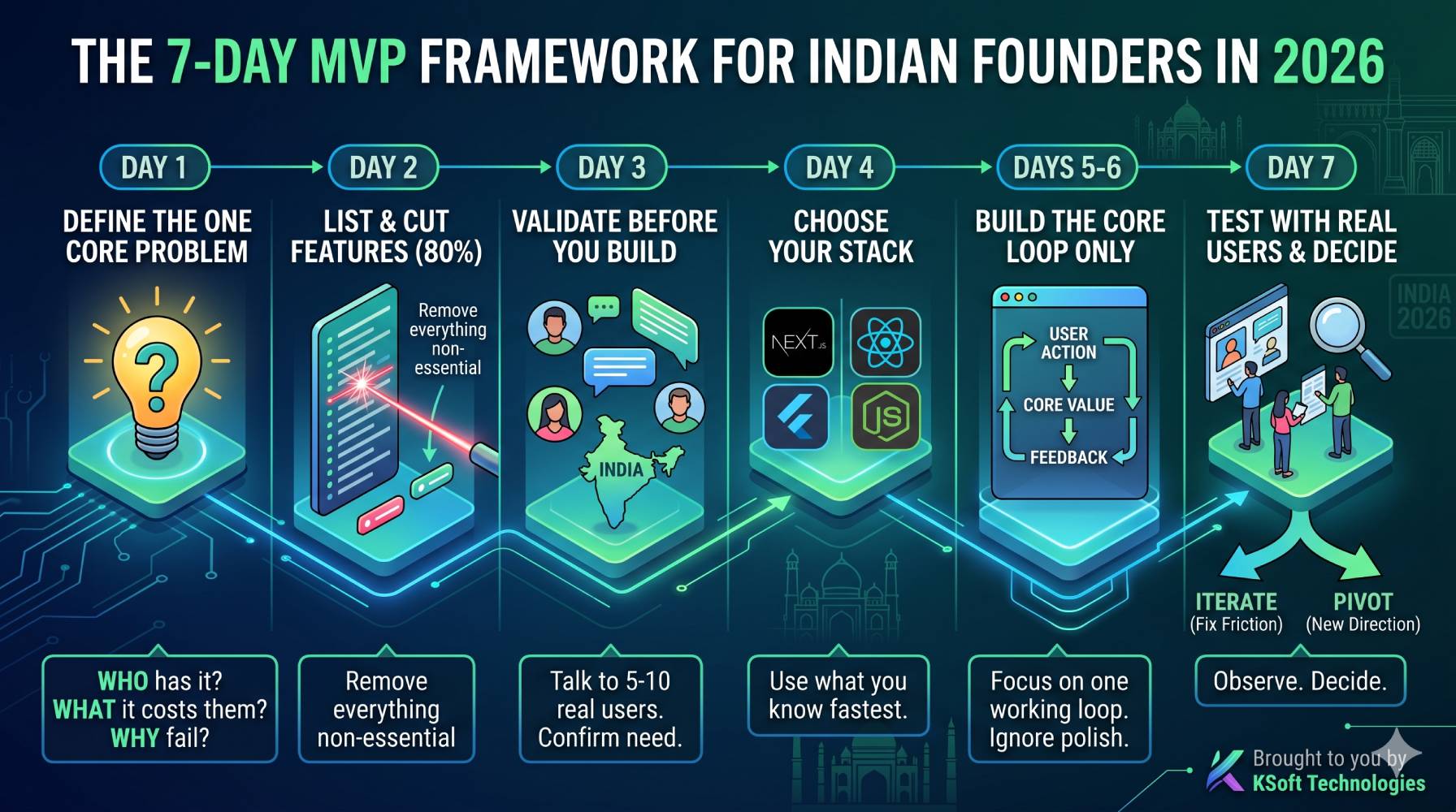
THE 7-DAY MVP FRAMEWORK
DAY 1 — DEFINE THE ONE CORE PROBLEM
Write one sentence: who has this problem, what it costs them, and why existing solutions fail.
If you can't write that sentence in under two minutes, you don't have enough clarity to build yet.
Example: "Freelance designers in India spend 4+ hours per week manually tracking client payments because existing invoicing tools don't support UPI reconciliation."
Real person. Real cost. Real gap. That's where you build.
DAY 2 — LIST EVERY FEATURE, THEN CUT 80%
Write everything you want to build. Don't filter. Get it all out.
Then ask for every feature: "Does removing this break the core value for the first user?"
If the answer is no — cut it. No exceptions. What remains is your MVP scope. Usually 2–4 core features.
DAY 3 — VALIDATE BEFORE YOU BUILD
Before writing a single line of code, talk to 5–10 real potential users.
Confirm three things:
1. They have the problem you described
2. They've tried to solve it and failed
3. They would use your specific solution
If you can't confirm all three, your assumption needs updating — not your product.
One conversation that changes your direction saves ten days of rebuilding.
DAY 4 — CHOOSE YOUR STACK (USE WHAT YOU KNOW)
Speed matters more than perfection at MVP stage.
Use whatever technology your team already knows fastest. For most Indian dev teams in 2026: Next.js or React for web, Flutter for mobile, Node.js or PHP for backend.
Don't learn a new framework to build your MVP.
DAY 5–6 — BUILD THE CORE LOOP ONLY
The core loop is the minimum path a user needs to take to get value.
For a payment reconciliation tool: connect bank → match transactions → mark as settled. That's it. No accounts page. No analytics. No email reports. Just the core loop.
Build that. Make it work. Don't make it beautiful yet.
DAY 7 — TEST WITH REAL USERS AND DECIDE
Put your working MVP in front of 3–5 users from Day 3.
Watch them use it. Don't explain it. Don't help. Just observe where they stop, where they get confused, and whether they reach the value.
Then make one decision: iterate (fix the biggest friction) or pivot (core assumption was wrong — back to Day 1 with new data).
WHAT MAKES THIS FRAMEWORK WORK
The reason most founders can't ship in 7 days isn't technical. It's psychological.
They want to build everything at once because they're afraid users will judge an incomplete product. But users don't judge incompleteness — they judge irrelevance. A focused product that solves one real problem always beats a bloated product that sort-of solves five.
The constraint of 7 days forces the question you should be asking anyway: what is the one thing this product must do?
COMMON MISTAKES TO AVOID
Building before validating — skipping Day 3 to save time loses more time than it saves.
Scope creep on Day 5 — "we'll just add this one feature" is how MVPs become 3-month projects.
Perfectionism on Day 7 — stop polishing. Ship it and let user feedback decide what matters.
Choosing the wrong stack — don't experiment at MVP stage.
WHAT COMES AFTER THE MVP
A working MVP in the hands of real users is the beginning of a startup, not the end of a sprint.
The data from your first 7 days of real usage is worth more than 6 months of planning.
At KSoft Technologies, the teams we work with that ship fastest treat the MVP as a learning tool, not a launch. The launch happens after you've confirmed the product works for real users.
FREQUENTLY ASKED QUESTIONS
How long does it actually take to build an MVP?
A well-scoped MVP can be built in 7–14 days. The variable is scope clarity, not development speed.
What should an MVP include?
Only the minimum features needed to deliver core value and test your primary assumption. Everything else is a distraction.
Do I need a technical co-founder?
Not necessarily. No-code tools work for many MVPs. For complex products, an experienced dev team that scopes and builds fast is often quicker than hiring.
What is the biggest mistake founders make?
Treating MVP like a full product. If your MVP takes more than 4 weeks to build, it's not an MVP.
ABOUT KSOFT TECHNOLOGIES
KSoft Technologies is a software development company based in Cherpulassery, Kerala, India — specialising in SaaS development, MVP builds, mobile applications, and custom ERP systems. 500+ projects delivered across India, UK, UAE, USA, and Australia.
Technical enquiries: https://www.ksofttechnologies.com/contact-us
Working through this in your own startup? Mentorship is where the clarity starts.
Apply for mentorship →